
Wednesday, January 1, 2014


Sunday, November 17, 2013
Nothing Comes Closer to Home

The newest tower on the forefront of the 70s building boom downtown was the Stouffer's Cincinnati Inn. Standing at 5th and Elm, it was the only hotel connected to the new Convention Center, both of which opened for business in 1968.


As popularity grew, Stouffer's had trouble meeting demand - from booming conventions to the Big Red Machine (source) - and hinted about expansion...

...until finally releasing plans to the public, which included a second tower:

In 1975, concept became reality - now 32-stories with 900 rooms and the major draw of the age: a revolving restaurant!
Presenting the new Stouffer's Cincinnati Towers:


Though, the party had to end at some point, with the Stouffer's hotel brand diminishing in quality in the 1980s.
The property changed hands several times over the following years - Clarion, Regal, Starwood/Sheraton - finally resting with today's owner.
The once grand Stouffer's presence is now curtained by the placid waters of the Millenium:

Still, some say that if you stand quietly in the lobby and close your eyes, you can catch a hint of frozen lasagna wafting through the air...
• A couple images above taken from the incomparable Cincinnati Views. Check it out for a little more info on the Stouffer's buildings.
• Timeline history of Stouffer's Restaurants & Hotels.
• Some dialogue about the old Stouffer's hotel.
• Review Cincinnati's push for a Millenium makeover.
• Stouffer's recent jump on the chuckwagon here (the vehicle).
• Stouffer's brand in the 90s, complete with emotional sax.
• Fairly unrelated, this Stouffer's ad displays a kitchen eerily similar to the one I grew up with. Faux brick and wood panel was the thing in the 70s.
Saturday, November 9, 2013
A Symbol(on) of Cincinnati
Earlier we reviewed a lost concept for Cincinnati's riverfront, which hinted at a towering structure on banks of the Ohio, not unlike that of a local project proposed around that same time: The Symbolon.

Detail from Riverfront Development Proposal (1961).
The Symbolon was to be a massive structure representative of the city - an idea sparked by the construction of Eero Saarinen's St. Louis Gateway Arch in the 1960s. From the book Unbuilt Cincinnati:
In the fall of 1961 - the same year that construction finally started on Eero Saarinen's St. Louis Gateway Arch - the Cincinnatus Association announced a competition for a Cincinnati Gateway Monument, or 'Symbolon' - symbolic of "the history, the character of the present city, and its future."
A jury of nationally prominent architects could not find enough merit in any of the 62 entries submitted and therefore declined, in October 1962, to name a winner.
The attention that the competition drew to the Riverfront is credited, though, for helping to pass the urban renewal bond issue in November 1962 and, ironically, for shifting the public interest from a Riverfront historical park to a Riverfront baseball stadium and to a Convention Center within the CBD.
This grand structure never breached the RFP stage, but imagine it had...
Perhaps the most recent representation of the Symbolon concept almost arose again at the turn of this century, only a boat ride away:

• Coming soon: Revisiting the grand revolving restaurants of Cincinnati's past, more Cincinnati Gateway projects, and the unbuilt Millenium Tower of Newport, KY.
Wednesday, November 21, 2012
On the Banks: A Googie Playground
With the massive Banks district currently under construction, and the city's progressive step in offering a form of crowdsourcing relating to this and other development (e.g. town hall debates, nomenclature polls, everyman architectural submissions), the future is lapping the banks of Ohio vigorously. Still, one could argue how its stylistic integrity stands against those of plans past.
For instance, this recent find:

While the rendering is interesting for its stadium proposal, the whole concept for redevelopment of the riverfront is of interest: a glorious transformation into a mid-modern Space Age wonderland.
Notably, almost every development proposal for the riverfront prior to mid-1960 seems to have a lone stadium west of the Suspension Bridge, but this one truly reflects the unique style of the era - an oval, lipped baseball stadium with Zig-Zag roofline:

Unless underground, the parking is notoriously absent here, except for the small lot to the west tied to the boxy International-Style Convention and Exhibition Center.
Then to the east, an interesting barrel-roofed structure sitting amongst the trees:

A planned historic memorial sitting among a miniature Central Park. And to the right: a water tower, or a rare rendering of the unbuilt "Symbolon"?
On to a curious part of this plan, and it stands front and center of the whole development. An anchor of this promising utopia on the banks of the Ohio...

Connected to a stilted boardwalk, holding two side-by-side sine wave-roofed structures, overlooking a grand riverside harbor, is the heart and soul of this vision:

Frisch's Mainliner #2 Restaurant, Cincinnati, Ohio (1944).

Another view (larger).
A double-wide Frisch's mega-restaurant?
Put on your Sunday best for this ultra-modern populuxe experience, where you'll be entrenched with mounds of powdered eggs and link sausage under a massive hyperbolic paraboloid! Take a look around:

Source: Cincinnati Views.
Of course, Frisch's was not to be front and center of this 1961 proposal, but the illustration does reference two of Woodie Garber's hyperbolic paraboloid structures, exactly as designed for his Frisch's Mainliner Restaurant (above).
This incredible plan also sparks interest into the historical concepts of what might have been on the riverfront, and prognostication of what tomorrow holds. And so, this starts yet another series on Cincinnati Revisited: On the Banks.
• More about Woodie Garber here.
• The "Symbolon", referenced in the rendering detail with the barrel-roofed structure, was to be a massive Cincinnati Gateway Monument. The 1961 construction of Eero Saarinen's St. Louis Gateway Arch became the impetus for a competition held by the Cincinnatus Association, which drew 62 entries, but no winner - thus, no structure was built.
• Check out Cincinnati Modernation's scavenger hunt for Zig Zag roofs in Cincinnati.
• The stadium illustrated in this 1961 Riverfront Development Proposal was added to the "Revisiting Cincinnati Stadia" post.
Tuesday, November 20, 2012
Regional Report: Cincinnati

"Regional Report: Cincinnati" by Ellen Brown, Good Food Magazine (September 1986).
In our last post we traveled to 1976 - touring Cincinnati's lively citizenry, urbane culture, and of course, culinary leanings.
Today we'll take a shorter visit through town, a decade later. The midwest in a clash between 19th-century footings and 80's opulence - maintaining both "grazing yuppies" and "Teutonic tradition" - as you'll see in this scant review on Cincinnati flavors for Good Food Magazine.
There are some interesting quotes that seem to transcend the ages...
"Decades have passed and skyscrapers have transformed the skyline, yet Cincinnati has not only weathered the change but thrived on it, with a unique blend of 19th-century architecture, Southern graciousness, and a magnificent natural setting on the banks of the Ohio River."
"...Further proof of the city's strong German heritage can be found any Saturday morning in the open-air Findlay Market, built in 1852. BMWs and Mercedes vie for parking spots with pickup trucks, and everyone searches for bargains on produce, farm-fresh eggs, and more."
...and a few that don't:
"Grazing yuppies love The Diner of Sycamore (...) and its homemade potato chips."
"...But most Cincinnatians don't care if every corner of other cities boasts a sushi bar. That's too trendy. What they look for is consistency and food as solid as a German burgher."
Thursday, August 30, 2012
Cincinnati, My Kind of Town
As we all know, Cincinnati is in the middle of a renaissance - neighborhoods are being rebuilt, arts scenes are vibrant, sports fans are cheering, home prices are fair, healthy transportation initiatives are on the right track, and overall livability seems at an all time high. The boisterous progressive attitudes here are only shadowed by the great things still to come.
There seems no end to this rolling stone that is Cincinnati.
And with this rejuvenation has come international praise, the most recent of which UrbanCincy reflects upon, which sparked today's post on the city's historical glow.
Here's a visit to the city of my youth - during the last great city expansion (1970s-1980s) - from May 1976 Ford Times article "Cincinnati, My Kind of Town". An issue probably more famous for Charley Harper's cover illustration:

Like most articles being produced about the city's developments today, this Ford Times article presents the city as kind of a niche locale with a surprisingly vibrant scene - in addition to the more notable sports' camps - and seems to miss on some of what us locals might consider crucial to the personality of Cincinnati. Nevertheless, it's media attention, and positive.
Here are some of the more descriptive passages from Ford Times author Nicholas J. Bush: (Delve into larger photos and read more of the article by clicking on the images below, or perusing the full article (link at end of post).)
"...I snap my mind to attention with pleasant thoughts about a city that would make Henry David Thoreau pack his bags and head back to town."

"...the city has a pleasant personality. It's evident at noontime on Fountain Square where on sunny days businessmen and women and families munch double-dip ice cream cones and enjoy a wide variety of entertainment scheduled..."
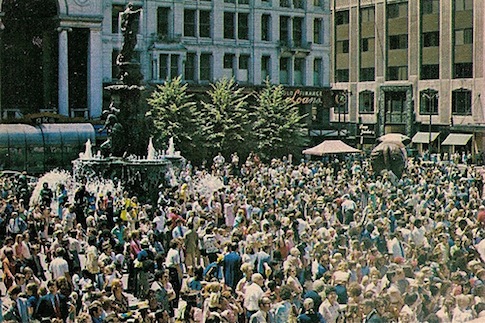
"For the life of me I find it hard to explain why the residents aren't terribly fat."

"Preparing your own food for an outing in Cincinnati is truly hauling coals to Newcastle - inferior coals, at that."
"When asked to rate Cincinnati chili, Texans are likely to turn red in the face and, if ladies are present, sputter something about 'that tendermouth slush.' What do they know? The cognoscenti among chili lovers agree: Cincinnati chili is the hautest of haute cuisine."

"A delightful town. Wonderful people. If you have the chance, drop by. It will do wonders for you."
• Read the complete 1976 Ford Times article "Cincinnati, My Kind of Town".
Related Posts
Tuesday, June 19, 2012
Editor's Note
We're back in full force here at Cincinnati Revisited!
Here's what's happening...
Here's what's happening...
• The recent induction of a new series, Blue Sky Cincinnati, where the crossing of nostalgia and futurism lay groundwork for concepts illustrating an optimistic Cincinnati landscape. The first article positing changes to the old 1970s-era Kings Islands Entrance showcases original concepts and artwork.
• Another recent series addition, Lawn Clippings, will focus on reviewing the city's fantastic, sprawling park system. Our latest visit to Smale Riverfront Park (Phase 1) highlights the fantastic new landscape through a series of photos.
And finally, don't forget about the other series started earlier this year:
• Cincinnati Stadia, reviewing the many local architectural wonders dedicated to sport. Be sure to check out the incredibly popular initial post of this series, Revisiting Cincinnati Stadia, which strolls through the magnificent unrealized visions of Cincinnati-past.
• Modern Transit, a retrospective of Cincinnati's more unique ventures in public transportation. Article one reveals the surprising international initiative that almost broke ground locally: Cincinnati Speedwalk.
Be sure to check back often for updates!
Monday, June 18, 2012
Blue Sky: Kings Island Entrance
The Kings Island's Amusement Park is one of Cincinnati's many city jewels. Not only is it a major Midwest entertainment venue that attracts millions of visitors to the area each year, but it's also a locale rooted deep in local history.
 Early Kings Island postcard (197x).
Click to view larger, via Cincinnati Views.
There are volumes of information about this on bookshelves and online, but the short story is that Kings Island is an incarnation of old Coney Island (the original version, on the Ohio River banks in Anderson), relocated to the broad, floodless acreage in Mason.
Coney's history can be traced to 1867, but by the mid 1960s, not only did old Coney run out of expansion room, but the river consumed it regularly, and luckily, local media-conglomerate Taft Broadcasting (who had recently bought Hanna Barbera, and wanted an attraction to showcase its characters) swooped in and bought the park. On the advice of Roy Disney, Taft bought 1600 acres of land to construct its new home, and in 1972, Kings Island (formed from the name of the area, Kings Mills, and in honor of old Coney Island) opened to great fanfare. And the rest is history (+).
Anyway, the subject of today revolves around the entry gates which are original to the park. It's a grand behemoth of 70s-era architecture that, while still relatively beautiful and well-kept (and reminiscent of that grand time when the park opened), could potentially use a facelift.
So, heeding the call from others, I decided to throw together a few concepts of what a change might look like.
So, heeding the call from others, I decided to throw together a few concepts of what a change might look like.
In reality, this would be renovation of a structure that still looks OK, still serves it's purpose adequately, and would probably not result in substantial revenue increase for the park (unless maybe part of an overall park theme upgrade). So, sidestepping the associated costs that would come with a complete tear-down-and-rebuild, I just explored several overlays to the existing structure.
THE PROCESS (Note: Click all images to view larger.)
First, homework and concept development:

Kings Island Entrance Gate overhead (2011).
Those blue ticketing / metal detectors prior to the entrance are now gone.
• Reflect the
history of Kings Island, through the original intent of a fully themed
amusement park (themed lands with corresponding architecture and design
elements).
• The front entrance, which sits on International Street
(buildings lined with Italian, Spanish, Swiss, and German motifs),
should be either American or French-inspired to create a
matching international-style bookend with the Eiffel Tower.
• The mansard roof of the existing structure fits with the French-born, US-prevalent, nostalgic Victorian Second Empire
architectural style. This style is also seen in various structures
throughout the park - including the oldest ride in the park, the Grand Carousel.
• Pull details from the original Disneyland gates, Hong Kong
Disneyland gates, Kings Island's Carousel, among other traditional
sources.
After research and finding an appropriate style that tied together Kings Island's history with corresponding visual elements, I laid down some quick visuals & notes to form the basis of the renovation concept.
Next step, sketch of the structure before-and-after:


Then, after a rough ink over the sketch, complete the template with more exacting measurements and final line art:
Then, after a rough ink over the sketch, complete the template with more exacting measurements and final line art:

On to color! In this case, it's a marker rendering:

The initial draft (above) is my favorite, but other iterations were created for test and comparison (see an edit of the first draft + a second version with color changes).
Acknowledging Cedar Fair's propensity for a bright palette - seen in the new Soak City Waterpark gate and other places - that second render reflected that (plus their brand colors).
One step further showcases a little more money put into an overhaul of the front gates to literally reflect the architectural style of the Soak City's gates. First, new line art, then wrapped with corresponding hues:

So that's it for now. Other items included in this exploratory were detailed illos + orthogonal views, which may be updated here later upon scanning.
One step further showcases a little more money put into an overhaul of the front gates to literally reflect the architectural style of the Soak City's gates. First, new line art, then wrapped with corresponding hues:
So that's it for now. Other items included in this exploratory were detailed illos + orthogonal views, which may be updated here later upon scanning.
• Review the whole process at my Blue Sky: Kings Island Entrance gallery.
• Sources for the history of the parks: Coney Island History, Kings Island Central, and Kings Island Park History.
Related Posts
Friday, June 15, 2012
Blue Skies Ahead

Another new series coming soon to the site: Blue Sky Cincinnati.
A workshop dedicated to the fantastical visions of what the local environment could've been and could still be. A harbinger of those great, lost, unrealized ideas of the past, and a promising template for the city's future.
Granted, these concepts will ignore the sky-high costs and critical public opinion probably associated with them, but hopefully will at least be some fun reading. The projects will be explored through various media - "sketches, concept art, models, and macquettes" - with all concept development and artwork completed in-house.
• Top image: skies above Mariemont High School stadium (5/14/11, 7:45p).
Wednesday, May 30, 2012
Lawn Clippings: Smale Riverfront Park (Phase 1)
Memorial Day Weekend is already behind us, and so the unofficial mark of Summer begins! And thus comes the first installment of our family's review of all the city's parks.
• • • • • • • • • •

Louis G. & Phyllis W. Smale Riverfront Park (plan), Cincinnati, Ohio.
I frightened guests at two local pools this past weekend, but it's a personal best for me to even think about removing my shirt on the first holiday opening. Luckily for onlookers at the initial development of Smale Riverfront Park, I didn't have my suit handy to make it a trifecta. Nevertheless, we trudged through the 90+ degree heat to scope out the new digs.
Here are a few highlights of our first trip to the new playground along the water's edge (click on the images to view larger w/ captions):


Cincinnati has been awaiting the opening of this new section of the riverfront - "Cincinnati's front yard" - and so far, the results are fantastic. It's amazing to think that this is just the beginning!
Interestingly, many times the reality of the final project doesn't live up to the expectations I've built in my mind around the initial, exalted concept illustrations (used as lures to develop the project). But in this case, just the opposite has happened - the park itself has outdone the sketches!
Let's review what was initially planned (Overview + Phase 1):
Overview + Initial Planning, Smale Riverfront Park (2009).
Phase 1 Update, Smale Riverfront Park (April 2012).

Phase 1 Map, Smale Riverfront Park.

Walnut Street Stairs + Bike / Visitors' Center, Smale Riverfront Park.

Schmidlapp Stage & Event Lawn (concept), Smale Riverfront Park.

Tree Grove (concept), Smale Riverfront Park.

Tree Grove + Labyrinth (concept), Smale Riverfront Park.
Now compare these illustrations with visitors' photos (i.e. my full photo set), and then check out the amazing new centerpiece of this long-awaited project for yourself!
Notes: It was in the 90s on Monday, so we didn't spend a huge amount of time outside. Here are the things we missed: Black Brigade Monument, Tree Grove + Labyrinth (only from afar), Bike Mobility & Visitors' Center + Bike Trail, The Women's Garden, and Main Street Garden.
For next time.
Notes: It was in the 90s on Monday, so we didn't spend a huge amount of time outside. Here are the things we missed: Black Brigade Monument, Tree Grove + Labyrinth (only from afar), Bike Mobility & Visitors' Center + Bike Trail, The Women's Garden, and Main Street Garden.
For next time.
• John G. & Phyllis W. Smale Riverfront Park main site.
• Learn more about Smale Riverfront Park at Sasaki Associates + meet the designers.
• Construction updates for the park here + video updates here.
• Support Cincinnati's Front Yard at Cincinnati Parks Foundation.
• Construction updates for the park here + video updates here.
• Support Cincinnati's Front Yard at Cincinnati Parks Foundation.
Related Posts
Tuesday, February 21, 2012
Modern Transit: Cincinnati Speedwalk
Matt Novak over at the Smithsonian blog, Paleofuture, recently posted a really great article on a radical concept for rapid transit that once swept over the world: Moving Sidewalks.
(I'm referring to those proposals for long distances, because as we all know, they already exist and work well in smaller-scale versions today.) Anyway, his article is a great source for the definition and history of the Moving Sidewalk as a mass transit system, so without regurgitating that info, I'll just review the few items relating Cincinnati's hat in this ring.
(I'm referring to those proposals for long distances, because as we all know, they already exist and work well in smaller-scale versions today.) Anyway, his article is a great source for the definition and history of the Moving Sidewalk as a mass transit system, so without regurgitating that info, I'll just review the few items relating Cincinnati's hat in this ring.
• • • • • • • • • •

"Closer Than We Think!" illo by Arthur Radebaugh.
Possibly the first touch locally for this transit concept was in “The Roads Must Roll”, a sci-fi short written by Robert A. Heinlein (1940), about future cities built around moving sidewalks.
In Heinlein's story, massive conveyors replaced highways and rail as the dominant form of transportation in the US, but as dependence on them grew, they were susceptible to sabotage, which forms the overriding plot (perhaps not unlike the real story of the automakers supplant of the US rail system). In his description of the landscape, he incorporates a Midwest trail which fairly resembles Ohio's scrapped 3C corridor:
Robert Heinlein imagined the United States—facing a war-strained petroleum shortage that meant the "end of the automobile era was in sight"—shifting to a series of massive commuter moving walkways. Of the first "mechanized road," built between Cincinnati and Cleveland [in 1960], Heinlein writes: "It was, as one would expect, comparatively primitive in design, being based on the ore belt conveyors of ten years earlier. The fastest strip moved only thirty miles per hour, and was quite narrow, for no one had yet thought of the possibility of locating retail trade on the strips themselves." (Source.)
And detailing it further:
...there is a massive network of parallel moving belts, the inner ones faster. Passengers are screened from wind, and there are chairs and even shops on the belt. In the Heinlein work the fast lane runs at 100 mph (160 km/h)... The relative speed of two adjacent belts is 5 mph (8 km/h) (in the book the fast lane stops, and the second lane keeps running at 95 mph (152 km/h)). (Source.)

In 1953, Goodyear turned fiction into reality. Contributing to the mass transit dialogue, they offered their industrial conveyor belts as peoplemovers, which perked up local ears:
From Time Magazine (1954):
The Goodyear Tire and Rubber Company proposed a new, technologically-advanced public transit system that wasn't quite "rapid transit," but was close enough. (Source.)
From Time Magazine (1954):
Goodyear has been working on the idea as a safe, fast method of travel in overcrowded cities. Last spring, with the Stephens-Adamson Manufacturing Co. of Aurora, Ill., its partner in the new belt company, Goodyear installed its first project: a $75,000 "speedwalk" to carry New Jersey commuters 227 ft. from the Hudson & Manhattan Railroad's Jersey City terminal up an incline to the Erie Railroad station.
Besides Manhattan, half a dozen big U.S. cities may soon be customers for the Goodyear passenger belt. Cincinnati is considering a belt-car system to serve 80 congested downtown blocks. So are Montreal, Cleveland, San Francisco, Atlanta, and São Paulo, Brazil, which is thinking of a web of conveyor-belt sidewalks. (Source.)
Popular Science (1954) continues:
Both New York City and Cincinnati are seriously considering plans for solving traffic problems with similar conveyor belts. In New York, a four-block-long system extending from Times Square to Grand Central Station has been proposed. This would take the place of overcrowded subway trains that now clatter back and forth over a so-called "shuttle" line. And in downtown Cincinnati, a two-way subway belt-conveyor loop has been proposed to uncork bottlenecks in a six-block-long and three-block-wide area. (Source.)

From the City of Cincinnati:
"The Passenger Conveyor Belt for Cincinnati" promised a "modern subway system" for the Queen City. This was an "ultra-modern transportation method" that would virtually eliminate motor and pedestrian traffic congestion, serving as the heart of the city's present public transportation system. It would even eliminate the need for most on-street parking in the main business district. (Source.)
Though, slowly, these unbuilt concepts began gathering dust as decades passed with waning local enthusiasm for this mode of transportation.
Yet, while conveyor belts for mass public transit became stale and unrealistic, there were areas of private infrastructure that handled enough bodies to float these concepts for themselves - seen throughout the world today, specifically in stadiums, theme parks, and airports - harkening back to an era of unabashed enthusiasm for grandiose ideals:
Yet, while conveyor belts for mass public transit became stale and unrealistic, there were areas of private infrastructure that handled enough bodies to float these concepts for themselves - seen throughout the world today, specifically in stadiums, theme parks, and airports - harkening back to an era of unabashed enthusiasm for grandiose ideals:
[In 1953] Goodyear suggested other uses for the Speedwalk. Modern airports could use the moving sidewalk for two-way transportation: passengers could walk while on the moving belt and increase their speed by 50 percent, or they could stand still on the belt while being carried through the airport... (Source.)

Finally, with a near palpable sense of nostalgia, the Cincinnati/Northern Kentucky Airport expansion in the 80s
& 90s - particularly the construction of Delta's hub (the massive Concourse B) - saw a spike in foot traffic and responded creatively:
A few novel ways to increase the flow of pedestrian traffic through the sprawling structure included the installation of the long-held dream: the Moving Sidewalk...
A few novel ways to increase the flow of pedestrian traffic through the sprawling structure included the installation of the long-held dream: the Moving Sidewalk...

...the only remaining tangible vestibule to this futuristic transit concept of Cincinnati's past.
Sources:
Matt Novak, Paleofuture blog / Smithsonian.com (January 11, 2012)
An idea for urban transport, cribbed from the airport.
Slate Magazine (July 6, 2010)
Time Magazine (November 15, 1954)
Popular Science Magazine (February 1954)
Further reading:
Mike Treder, Institute for Ethics and Emerging Technologies (August 9, 2009)
Cedric Benetti, Paris 2e (April 2, 2008)
Matt Novak, Paleo-Future (June 25, 2007)
James R. Berry, Mechanix Illustrated (November 1968)
Subscribe to:
Posts (Atom)





