Showing posts with label Parks. Show all posts

Wednesday, May 30, 2012

Lawn Clippings: Smale Riverfront Park (Phase 1)

Memorial Day Weekend is already behind us, and so the unofficial mark of Summer begins!  And thus comes the first installment of our family's review of all the city's parks.

• • • • • • • • • •

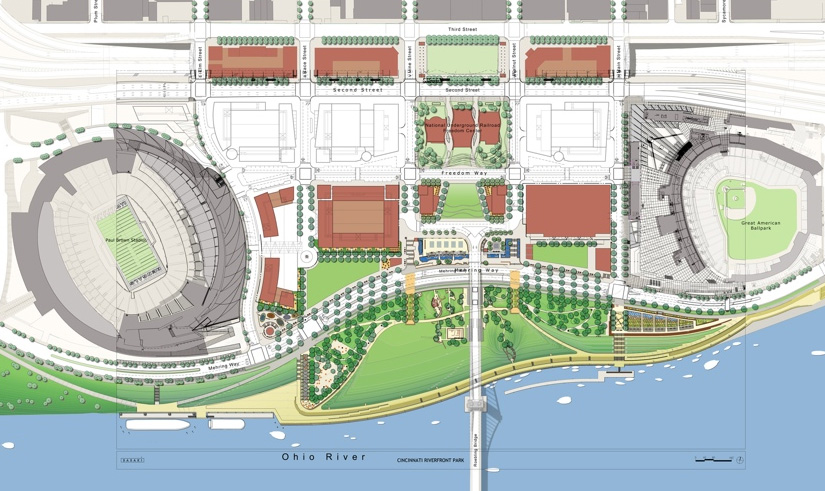
Louis G. & Phyllis W. Smale Riverfront Park (plan), Cincinnati, Ohio.

I frightened guests at two local pools this past weekend, but it's a personal best for me to even think about removing my shirt on the first holiday opening.  Luckily for onlookers at the initial development of Smale Riverfront Park, I didn't have my suit handy to make it a trifecta.  Nevertheless, we trudged through the 90+ degree heat to scope out the new digs.

Here are a few highlights of our first trip to the new playground along the water's edge (click on the images to view larger w/ captions):


Cincinnati has been awaiting the opening of this new section of the riverfront - "Cincinnati's front yard" - and so far, the results are fantastic.  It's amazing to think that this is just the beginning!

Interestingly, many times the reality of the final project doesn't live up to the expectations I've built in my mind around the initial, exalted concept illustrations (used as lures to develop the project).  But in this case, just the opposite has happened - the park itself has outdone the sketches!

Let's review what was initially planned (Overview + Phase 1):

Overview + Initial Planning, Smale Riverfront Park (2009).

Phase 1 Update, Smale Riverfront Park (April 2012).

Phase 1 Map, Smale Riverfront Park.

Walnut Street Stairs + Bike / Visitors' Center, Smale Riverfront Park.

Schmidlapp Stage & Event Lawn (concept), Smale Riverfront Park.

Tree Grove (concept), Smale Riverfront Park.

Tree Grove + Labyrinth (concept), Smale Riverfront Park.


Now compare these illustrations with visitors' photos (i.e. my full photo set), and then check out the amazing new centerpiece of this long-awaited project for yourself!

Notes: It was in the 90s on Monday, so we didn't spend a huge amount of time outside.  Here are the things we missed: Black Brigade Monument, Tree Grove + Labyrinth (only from afar), Bike Mobility & Visitors' Center + Bike Trail, The Women's Garden, and Main Street Garden.
For next time.

• John G. & Phyllis W. Smale Riverfront Park main site.

• Learn more about Smale Riverfront Park at Sasaki Associates + meet the designers.

• Construction updates for the park here + video updates here.

• Support Cincinnati's Front Yard at Cincinnati Parks Foundation.

Related Posts

Sunday, December 4, 2011

Revisiting Cincinnati Stadia

 Cincinnati Riverfront Master Plan
+ Overview of proposed Smale Riverfront Park.

There's been a lot of talk lately about how to make the operations for the recently built stadiums on the riverfront profitable (or at the very least balanced) - with the funds annually threatening red, resulting in secret backroom deals, general anxiety, and who knows what else.  Since the plow hit the soil, it seems, questions persist as to whether the county received a bad deal (+), and whether stadium construction in general creates the substantial societal and financial impact that the public is promised.

Having taken the guided behind-the-scenes tours of both new riverfront facilities, and attended numerous events in all big four local stadiums, I've come away with these general observations of the existing Cincinnati mega-stadiums (click on any image for a larger view):

Great American Ballpark was designed comfortably - enjoyable just to meander throughout, with unique lures / stopping points spread between each section - and feels like part of a neighborhood, even when closed.  The attached Hall of Fame Museum adds to the stadium's perception of year-round accessibility, but the fact that the season is 6+ months long alone lends to its true viability.  When not watching the main event, there's plenty of family-oriented + adult-centric things to do to enjoyably bide the time.

Great American Ballpark, Cincinnati riverfront.
First-generation rendering of the new riverfront ballpark.
Image source: UrbanCincy + Hamilton County.

Lindner Family Tennis Center is actually comprised of four stadiums (Center Court, Grandstand Court + 2 additional with seating) + many other satellite courts. Located in Mason, there's room for growth indefinitely, and with its continued expansion (through bricks & mortar + tournament building) its relevance on the world stage is continually amplified. Even with its roomy suburban digs, the grounds are oriented so that meandering between matches on several different courts is easy, with the stadiums themselves airy and comfortable.  Great food, shopping and tennis facilities overall draw fringe jocks to socialites and everyone else in between, resulting in a vibrant mixture during the day or evening daily sessions.  It also doesn't hurt that the complex sidles the Jack Nicklaus-designed Kings Island Golf Center + Kings Island itself, among other attractions.  A veritable playground.

Lindner Family Tennis Center, Mason, Ohio.
The latest master plan expansion for the burgeoning Cincinnati tourney.
Image source: W&S Open.

Nippert Stadium is shoved so tight within UC's campus that it's hard for it to breath, so expansion proposals are often unique concepts (rarely ever actually realized) - though, this restriction is a blessing in disguise: Walking around a huge stadium without encountering acres of parking asphalt is a godsend.  Instead, it's surrounded by some of the most amazing architecture and a vibrant student population, which makes it feel like a lively city within a city, which is very cool.

Nippert Stadium, University of Cincinnati.
Nippert is just one part of UC's huge sports complex, which hosts
a ton of teams' fields, courts, etc.

Paul Brown Stadium - a huge leap from the Bengals original home in Nippert Stadium (1968-69) - is architecturally significant and provides great aerial shots, but when inside, the Brutalist-like concrete interior on cold game days kind of makes you feel like you're on the movie set of One Day in the Life of Ivan Denisovich...or maybe a zoo holding pen.  It would be nice if pre- or post-game attractions were built into the stadium somehow to extend its gameday (or potentially game-week) life, but I'm not familiar with them (if they exist).  For the most part, tailgating is stuck to the underpasses and the rest to the bars, but I'll bet that those living in the Club-level have a much different take on this.

Paul Brown Stadium, Cincinnati riverfront.
Designed by NBBJ Sports and Entertainment Architects of LA.
Image source: Cincinnati Enquirer.

Anyway, it's ironic that of all the stadiums in town, Paul Brown Stadium was the most expensive to build, has produced the least-winning teams, is used the least period of time (just 10 days/year for the Bengals), and most importantly, is the most shut off from the surrounding environment even though it lives in arguably the most prominent neighborhood in the city: the Riverfront District.  I'm no fair-weather fan and am glad we have a pro team, but... well, I'll leave it at that.

Still, overall, I'd say yes, the stadiums impact the city in a socially and financially significant (usually positive) way - its hard to imagine what the city would be without them. Not only do they draw international interest, but enliven the residents, and overall, make the city money.  They make our mid-size city feel much much larger, and frankly, we're lucky to have these assets.

The X-factor, of course, is the main event: whether we win or lose.  Even when the city went through massive renovation and growth (business and construction) primarily in the late-70's to 80s, I've heard some say that the optimistic air surrounding that "boom time" was attributed greatly to our dominance in pro sports.  That's the perception, and as a result, perhaps the true value of the stadiums - the city's collective attitude buoys with the teams' successes or failures, and thus, sometimes how the structures themselves are received.

Nevertheless, bucking the long-standing perception of Mark Twain (et al.) that the city is intolerant or slow to change, no matter the population numbers, economy, team scores, or outcome of concept, Cincinnati never ceases to dream big, which itself makes this this relatively small town always feel like a promising metropolis.

So, riding this optimistic wave of idealism, here's a short retrospective of some of the great initial, conceptual illustrations of these behemoths + fantastical stadium visions that never got off the drawing board:


Cincinnati Riverfront Rehabilitation proposal (1926).
Note the rudimentary football/track field in the middle, obviously unbuilt.
Image source: Cincinnati Transit.


Cincinnati Riverfront Redevelopment plan (1948).
Another unbuilt stadium proposal for another unbuilt riverfront concept (view larger).
Image source: Cincinnati Transit.


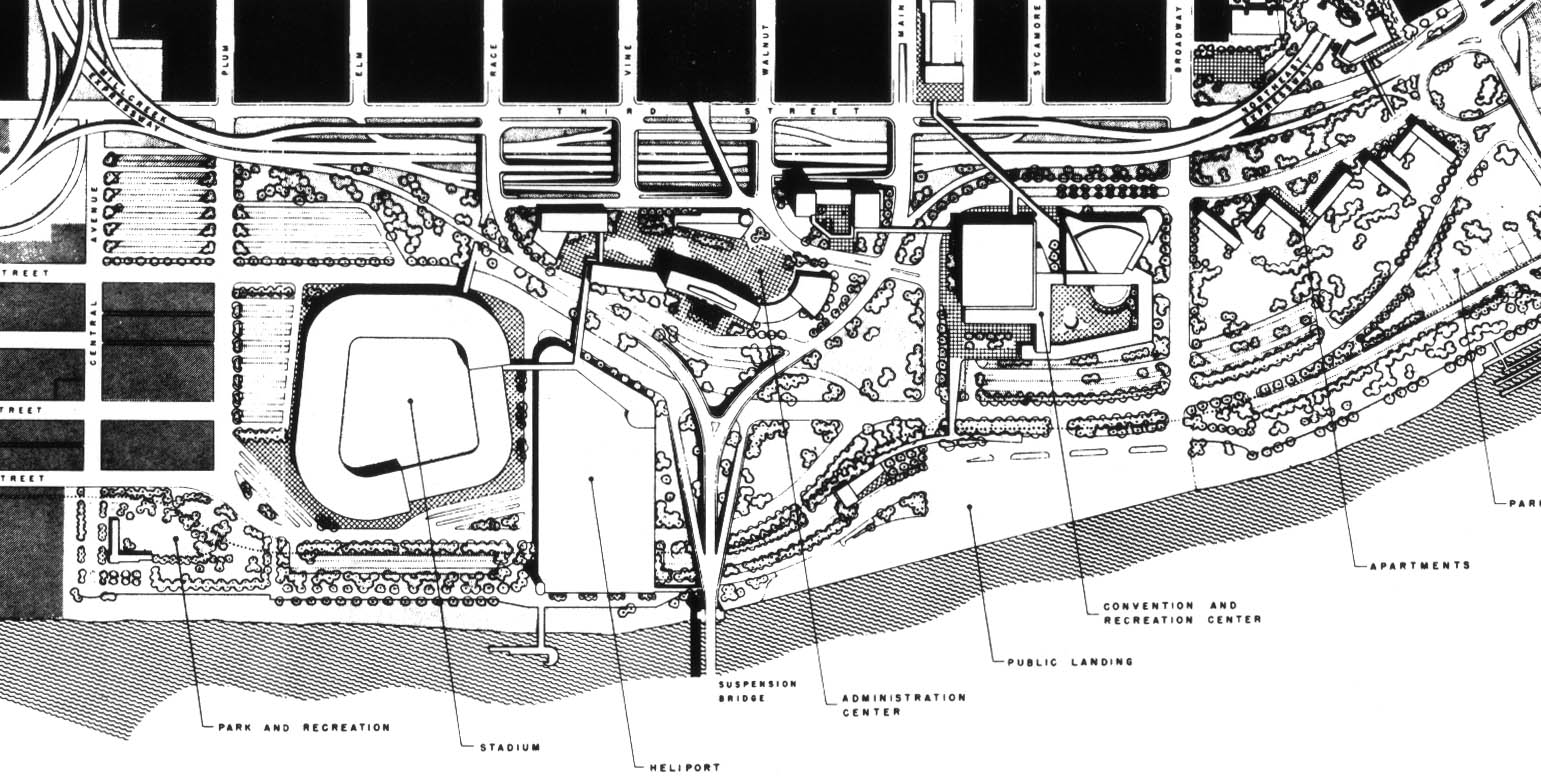
Cincinnati Riverfront Development proposal (1961).
Including an unbuilt baseball stadium concept (more info).
Image source: Cincinnati Enquirer (2/19/63).


Riverfront Stadium concept (1966). 
A proposed domed stadium on the site of the then Riverfront Stadium.
Image source: Visual History Gallery.


Cincinnati Riverfront Redevelopment concept (early 1990s). 
Commissioned by the then-city manager during the city boom era & early talk
of The Banks, this shows the stadiums on opposite ends of the city from where they exist now.
Image source: UrbanOhio.


Riverfront Stadium / Cinergy Field renovation proposal (1997).
This plan would've saved some bucks by retrofitting the existing stadium
instead of building the new one we have today.
Image source: Cincinnati Enquirer.


Cincinnati Reds stadium proposal, Broadway Commons (1998).
A failed attempt to move the new stadium to Over the Rhine.
Image source: Cincinnati Enquirer.


Great American Ballpark, early concept (1998).
In the fight against the Broadway Commons proposal, the Reds released this rendering of
keeping the stadium on the river.  It obviously was built here, but with a different design.
Image source: Cincinnati Enquirer.


Paul Brown Stadium + Great American Ballpark vision (1998).
A broader view of the riverfront with the Reds Stadium concept shown above.
Image source: Cincinnati Enquirer.


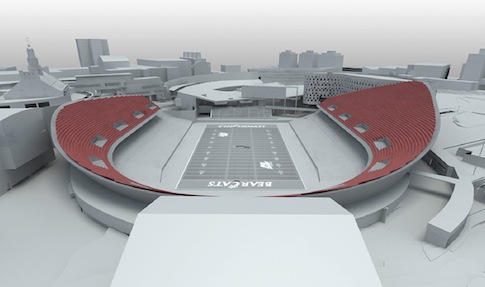
Nippert Stadium expansion proposal, University of Cincinnati (2008).
Very cool unbuilt concept that fits in with the contemporary feel of the new campus.
Image source: UrbanCincy + Trahan Architects.


Cincinnati's 2012 Olympic bid, event facilities (2000).
A proposed retrofitted, domed Nippert Stadium would've hosted gymnastics.
Image source: Cincinnati Enquirer.


Cincinnati's 2012 Olympic bid, master plan (2000).
This grandaddy of all Cincinnati master plans showcases a transformed riverfront which
would've included an Olympic Stadium, left, and other supporting fields/stadiums.
Image source: Cincinnati Enquirer.


Read more about the general impact of stadiums: 
Do New Stadiums Have an Economic Impact? from Diehard Sport
Sport, Jobs, & Taxes: Are New Stadiums Worth the Cost? from Brookings Institution
The Stadium Gambit and Local Economic Development from Regulation Mag / CATO Institute
The Economic Impact of Sports Facilities from The Sports Digest
Corporate Welfare, Publicly Funded Stadiums (+ comprehensive link list) from AK Dart

Friday, October 16, 2009

The Kilgour Peace Offering

 Kilgour Fountain at Hyde Park Square [1901].
Image source.


In relation to the last post (and the importance of constructing something tall as a central locator and gathering place for the neighborhood), here's a little more info on the history of the Hyde Park Square fountain & esplanade:
"Appeasement rather than gratitude was one reason for the construction of the fountain... The work, designed by Joseph F. Cronin, was a gift in 1900 from the Kilgour family. The Kilgour brothers were part of the syndicate that developed the triangle of land between Madison Road, Observatory Avenue and Edwards Road around the turn of the century.

"Dubbed 'Genevieve' by generations of residents... The Kilgour Fountain was a gesture of good will to calm furor caused by the extension of the trolley tracks from Delta Avenue to Madison Road, disrupting the tranquility of a few bordering streets. In addition, the farsighted syndicate wanted to beautify the shopping district planned to be in walking distance of their developed property." (Source: Cincinnati Magazine [September 1975].)
Amazing. The fountain was a gift to the neighborhood from the Kilgours because of the disruptive nature of construction of the local public trolley line.  A far cry from today's world.

The Kilgours were a major presence in the area of the time: John Kilgour, a wealthy Cincinnati banker & President of the Cincinnati Street Railway, and his brother, Charles Kilgour, a wealthy real estate investor & street railway engineer. They helped to develop Hyde Park into an area strictly for the wealthy, contributing the land for the Cincinnati Observatory (moved from Mt. Adams, which also gave Mt. Lookout its name), and dedicating the "Kilgour Esplanade" (Hyde Park Public Square) to the village of Hyde Park (July 21, 1900). 
Sources: City of Cincinnati - Parks Dept, Cincinnati Enquirer, and "Cincinnati: A Guide to the Queen City and its Inhabitants" by the Federal Writers' Project (p.306, 307).

Read a short history on the development of Hyde Park by the Hyde Park Neighborhood Council, and Mt. Lookout's history at the Mt. Lookout Community Council & P&G.

• Current info on Hyde Park at soapbox!, and a great photo of "Genevieve" here.


• • • • • • • • • • 

Finally, here a couple more recent photos of the fountain getting its Fall bath before closing down for the colder months...or maybe just a good old fashioned soap tagging by those wild and crazy neighborhood kids:


All photos taken 9/25/9.

Saturday, October 10, 2009

Riverside Rail

 Rail along Riverside Drive
(Pre-Towne Properties development).
Photo source.
 

It was my son's birthday recently, and a heck of a good day it was. After all of the day's expected rigmarole, we decided to cap it off with a cruise around downtown - something he enjoys immensely, even at this young age. Whether it be kid-size or adult-size, tunnels, towers and trains are his favorites, so when near the core, we always visit the Queen City Square tower construction site, and drive to or fro through the 71/3rd Street tunnels (and usually once back and forth over the Roebling Bridge, aka. the "Buzzing Bridge"). Unfortunately, seeing trains of any kind is unusual... which made this birthday trip extra special.

First, the normal routine (with an added bonus)...


The Queen City Square tower, looking NE from 2nd Street...


...and a plane with a flag attached to it!
Planes AND flags = hysteria.

After hitting the business district, we ventured down through beautiful Sawyer Point - an area that seems to be incredibly under-utilized by the population (aside from the formal, scheduled events - from what I've witnessed, anyway). It's surprising, too, considering there's so much to do and see just strolling around the area. No matter how many times I've been down there, it still hits me as a really incredible park...


Looking south from Sawyer Point's "Gateway Sculpture"
toward the "Big Mac Bridge".

Floating sticks down the miniature Ohio River - something I used to love doing
as a kid when it first opened in '88. Can't do it anymore, though,
since they don't keep the water pumping.

Waving flags against a moving sky. Pretty mesmerizing when
you're young...
and they're everywhere at Sawyer Point.

That was our final stop sans car, so after buckling in again for the ride home, I decided to take the scenic route, down Eastern Ave. Riverside Drive, and I'm glad I did because we ended up witnessing a small clip of the past future...


It was obviously a Cincinnati Dinner Train excursion, because there were only a few cars, it was moving pretty slow, there were people lounging around inside and on the rails checking out the view, and it was Saturday night. And as simple as this was, it was damn beautiful, and my son loved it.

A great end to a great day.

Aside:
This might not be a big deal to some of you, but like most of the rest of the country, passenger trains are extremely scarce around these parts anymore - especially any place other than Union Terminal, so seeing any train wheeling down the east side of town takes me by surprise. Naturally, I stopped to witness the grandeur, and wheeled up onto a small side street, got out and snagged a few, quick shots. This actually was a good experience, because I had never actually noticed how close the tracks were to the backs of some of those houses perched up off of Riverside Drive, and how little noise the train actually made next to them.

While I don't drool over everything Towne does, I do appreciate their local prominence because they've rebuilt a ton of older areas into attractive hot spots. But in regards to Riverside, I really don't know what the heck Arn is complaining about. Not only did the Cincinnati Dinner Train not seem very disruptive (similar, if not heavier and louder than the modern 3-C cars that would travel here), but having passenger trains travel through the area and stop in the heart of all the city's new construction three times a day seems like a no-brainer in terms of creating prosperity and vitality for our city. Isn't that what developers ultimately want?

Arn is obviously protecting those who have already bought from him down there, but if those residents don't like it, I'm sure there'd be a ton of people itching to buy property in their place if it meant being near a rail stop. Wasn't that always the plan???


Concept drawing of the Riverfront Transit Center (1997).
This was obviously constructed some time ago, but where's the rail?
Or the bus traffic for that matter??

Update: Lunken was approved as Cincinnati's "temporary" depot. Seeing that the Union Terminal was nixed from the get-go (no room with the freight traffic there), and the huge 2nd Street structure foolishly ignored (above image), I guess I don't have a problem with this - it's a cool, old stop that already caters to the transient tourist/business passenger dynamic. But if the streetcar is ever constructed and doesn't have a line passing near there, none of it will make any sense... or cents.

• More on the Cincinnati Dinner Train and other unique rail events at
The Cincinnati Railway Company (more info at Discover Ohio, CincinnatiUSA.com & a nice writeup at Shore Magazine).


• Read an exceptional writeup of the barren Riverfront Transit Center at the always excellent Queen City Discovery